


- Nine years after first announcing it would build a successor to the original Roadster, Tesla has unveiled it.
- Elon Musk promised rockets, and it most certainly does have rockets, as well as a ground effect fan system.
- The Roadster with rockets will, well, rocket to 100km/h in under a second.
Tucked inside a pristine SpaceX hangar in Texas, Tesla finally pulled back the velvet curtain on its long-awaited next-generation Roadster last week. It's been close to a decade in the works, with Elon Musk making all his usual wildly outlandish claims about it having rockets and being the fastest accelerating car ever along the way.
But in a surprising twist, what was revealed was not only a car that lived up to those claims, but also added a few more crazy features on top. Well... sort of, because as with all things Tesla, there were a number of significant caveats that came out after the smoke from the flashy presentation - that went of largely without a hitch this time - had cleared.
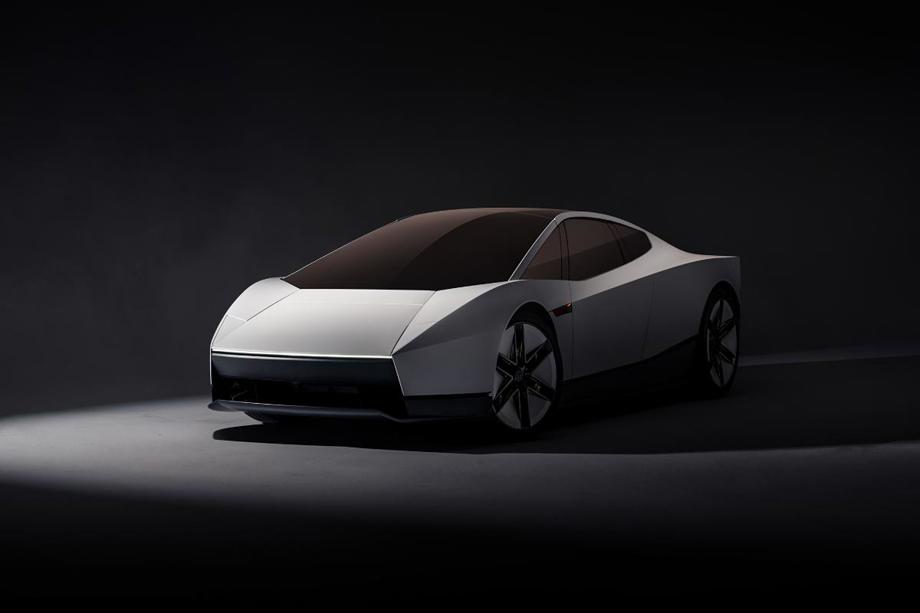
Designed by Franz von Holzhausen with sharp white panels and aerospace-inspired lines, the Tesla Roadster looks equal parts supercar and origami, with clear inspiration taken from the 60s and 70s "wedges" like the Lamborghini Countach, Lancia Stratos Zero and Lotus Esprit (particularly the white submersible one from the James Bond movie For Your Eyes Only, that Elon happens to own...) that inspired the Cybertruck, but that look far more at home here.
But as the demonstration quickly showed, the real magic sits beneath the skin.
Ditching All-Wheel Drive for Pure Rear-Wheel Mayhem
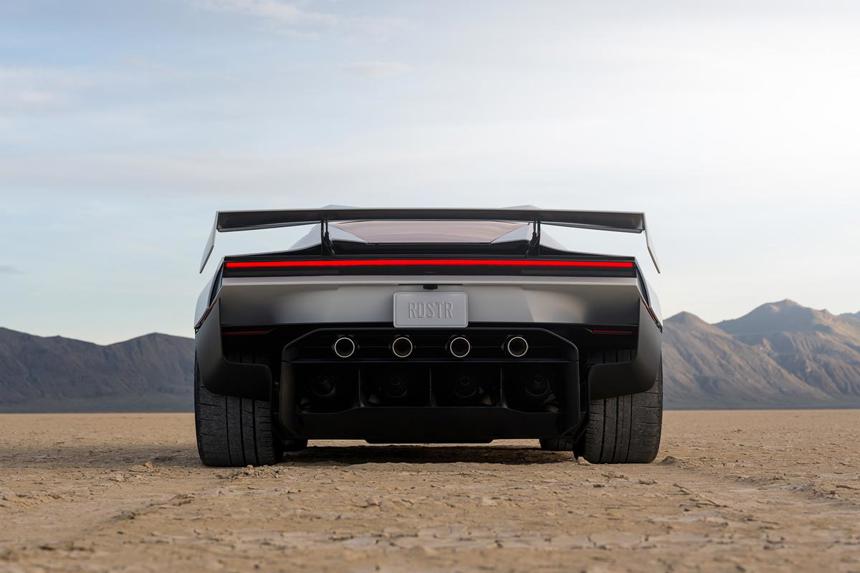
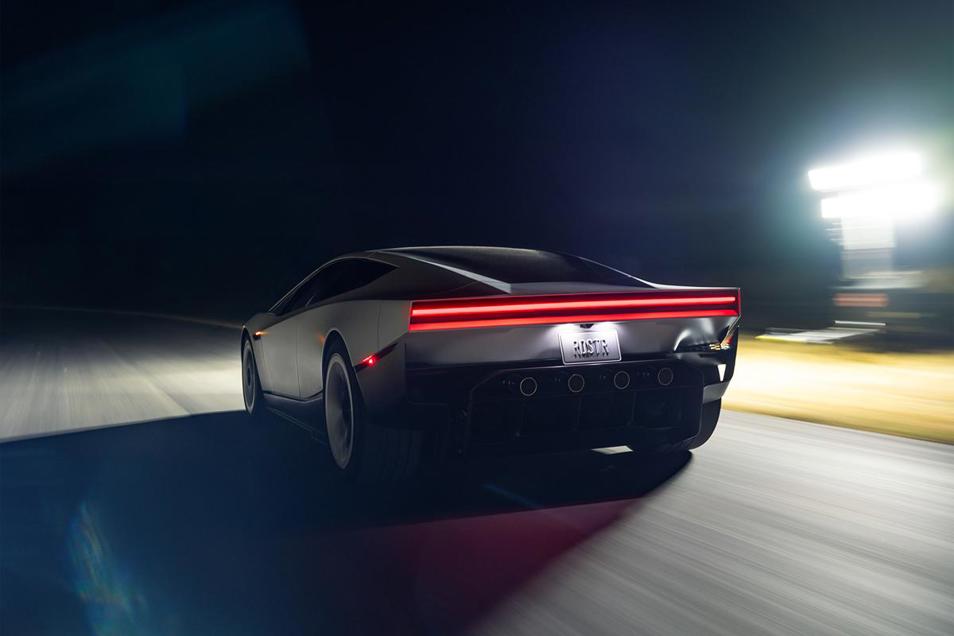
One of the biggest surprises not actually mentioned at the launch event is the fact that the Roadster is rear-wheel drive. Given that Tesla built its reputation for face-melting acceleration on all-wheel-drive setups, this callback to the original Roadster is a surprising shift, particularly given te new versions savage acceleration potential.
According to Tesla’s Vice President of Vehicle Engineering, Lars Moravy, the engineering team wanted a "visceral, emotional driver’s car" with massive torque pushing from behind. Packed into the rear axle are two ultra-dense electric motors that put out over a megawatt of power - yes, that's more than 1000kW - and over 1400Nm of torque. That means just two rear motors send more power and torque through the back tyres than all three motors combined in a Model S Plaid.
Instead of using a heavy, traditional mechanical differential, power flows through a tight planetary gear set with an 8.4 reduction ratio. Paired with independent motor inverters, the car precisely controls how much power each individual rear wheel receives in real time. Which it will certainly need.
A Lighter Battery Built for Track Day Stamina
High-performance electric cars usually suffer from two major headaches: heavy weight and thermal overheating during track driving. Tesla tackled both problems by developing a custom version of its 4680 battery cell.
Unlike typical battery cells housed in steel cans, the Roadster uses aluminium cell casings. Aluminium is significantly lighter and transfers heat much faster. To cool them down, Tesla designed a double-sided cooling jacket that flushes liquid coolant straight through the pack in a single pass. By constantly pushing cold fluid from one side to the other, the system maintains a level temperature across the entire battery.
The pack also uses a tailor-welded titanium upper plate for lightweight heat protection and an aluminium lower plate for impact resistance. Powered by an 800-volt electrical architecture, Movray says Tesla is aiming to charge the pack from 15 percent to 80 percent in just 10 minutes, giving drivers 25 to 30 minutes of continuous track driving before needing a quick break.
Best of all, Moravy says Tesla has kept the total vehicle weight just under 1700 kilograms, making it surprisingly nimble for an electric car.
Transforming Aero and Robot-Powered Wings
The Roadster’s carbon-fibre bodywork is packed with active aerodynamic tricks that transform its shape depending on how fast you are driving.
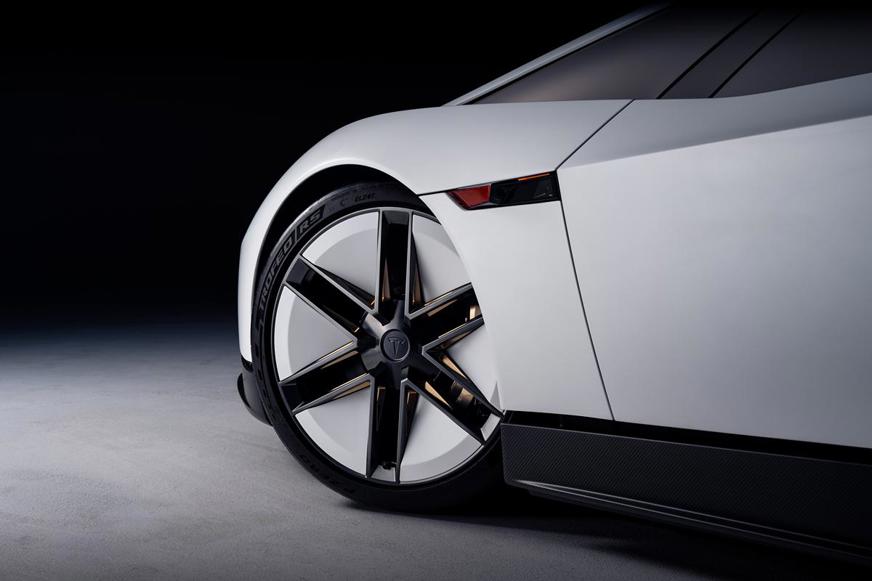
Up front, the headlights do not pop up; instead, ultra-thin 15-millimetre modules pop down to reveal high-beam lights. Active vents above the bonnet and hidden barge boards along the sides pop outward to redirect airflow around the body. Inside the front nose, internal wings can pivot up to 80 degrees to channel air under or over the vehicle.
At the back, a massive rear wing transforms the car's profile to create up to 2Gs of downforce at speeds over 320km/h. To push against thousands of newtons of aerodynamic force, Tesla borrowed heavy-duty leg actuators directly from its Optimus humanoid robot program to move the rear wing.
Breaking the Laws of Traction with Vacuum Fans
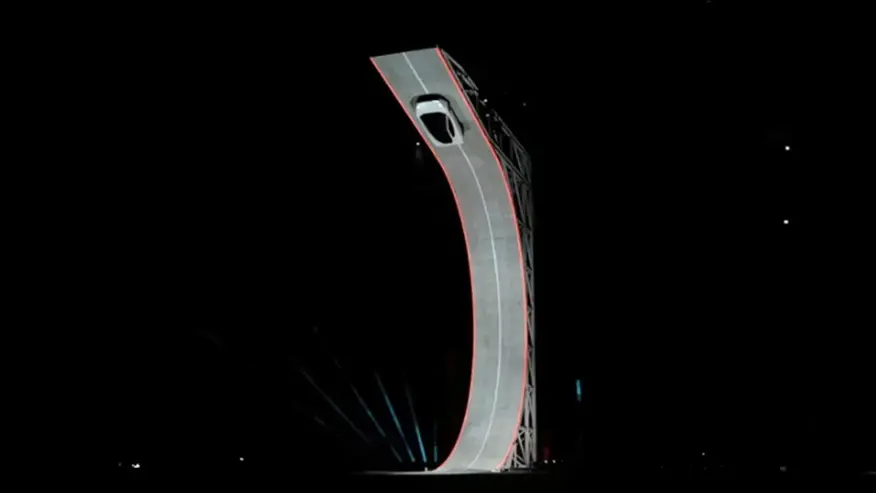
Another unexpected surprise Tesla debuted on the Roadster was a ground-effect fan suction system. Similar to systems in Gordon Murray's T.50 and original Brabham BT46B F1 car, but more like the recent McMurtry Spierling, that system uses four high-voltage fans mounted underneath the car. When activated, four "sacrificial" rubber skirts with nylon bristles drop down to seal the underbody against the road.
The fans pull air out from underneath the car, creating a strong vacuum that clamps the chassis to the ground, providing over 2Gs of cornering grip at speeds under 80km/h, and even from a standstill, allowing the Roadster to drive upside down. When speed hits 320km/h the skirts open back up, allowing the fans to blow air out the back like an active diffuser.
Yes, it does have rockets
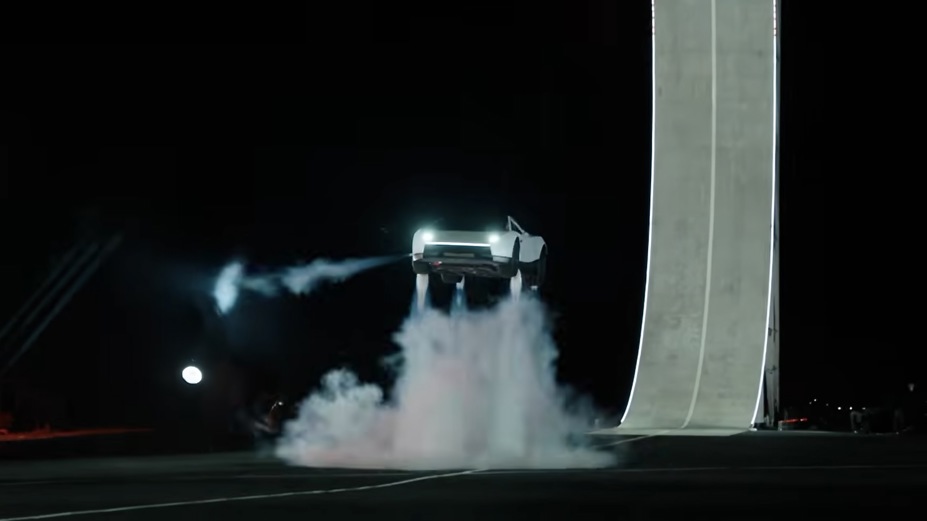
True to Elon's word, the new Roadster does have rockets - or at least, some of them do. The Roadster is being offered for order in three variants: Performance, Thrust and Rocket.
The Performance model uses the dual-motor rear-wheel-drive powertrain and the fan vacuum system, but has no rocket thrusters. It still hits 0 to 60mph (96km/h) in a blistering 1.6 seconds with a top speed of 340km/h.
The rockets come with the Thrust and Rocket models. The rockets, in this case, are actually case cold gas thrusters that operate on pure pneumatic pressure using compressed nitrogen gas stored at an astonishing 10,000 PSI inside a carbon-overwrapped pressure vessel (COPV).
Unlike chemical rocket engines, there is no combustion or heat involved; the system functions similarly to satellite orientation thrusters, drawing on nitrogen because it is clean, non-thermal, safe, and makes up roughly 80 percent of Earth's atmosphere.
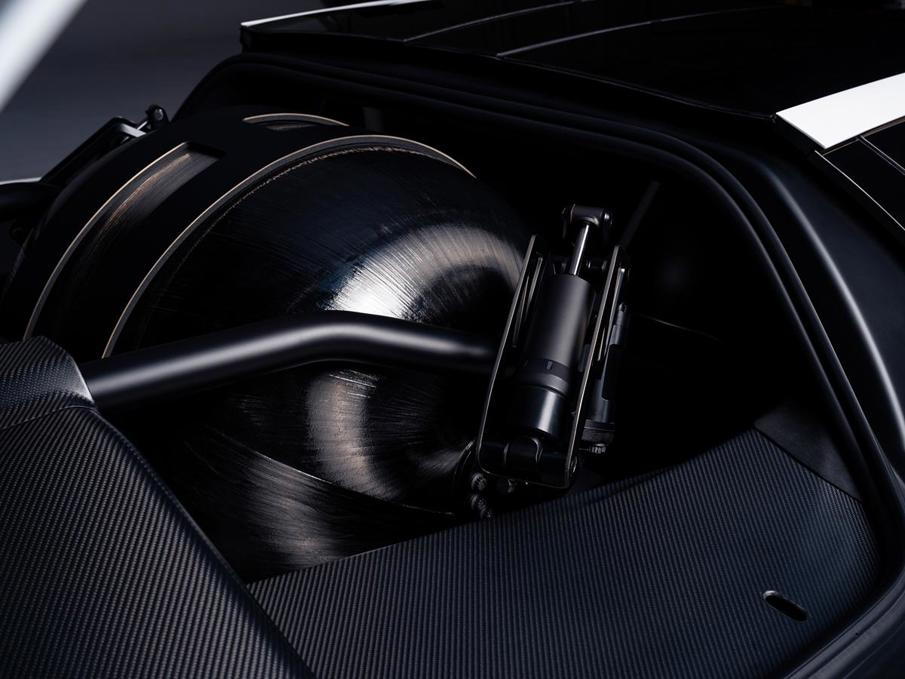
The COPV itself is a sphere- or bowl-shaped composite vessel engineered to distribute extreme internal pressure evenly without structural weak points. When activated, a heavy-duty valve actuated by a leg motor repurposed from Tesla's Optimus humanoid robot opens to release the pressurised gas. The nitrogen shoots through tailored nozzles in a supersonic stream, creating visible shock diamonds at the exit.
The result is sheer explosive force: discharging the nitrogen generates over 80 kilonewtons of thrust, which is comparable to the output of a single fighter jet engine.
The Thrust model uses its rockets purely for acceleration, adding a 200-litre COPV holding compressed nitrogen gas at 10,000 PSI, feeding the thrust through four rear nozzles. Working together with the electric motors and vacuum fans, it launches from 0 to 60 mph in 0.85 seconds (or 0.55 seconds with Tesla's standard rollout subtracted), subjecting the driver to over 5G of acceleration while boosting top speed to 370km/h.
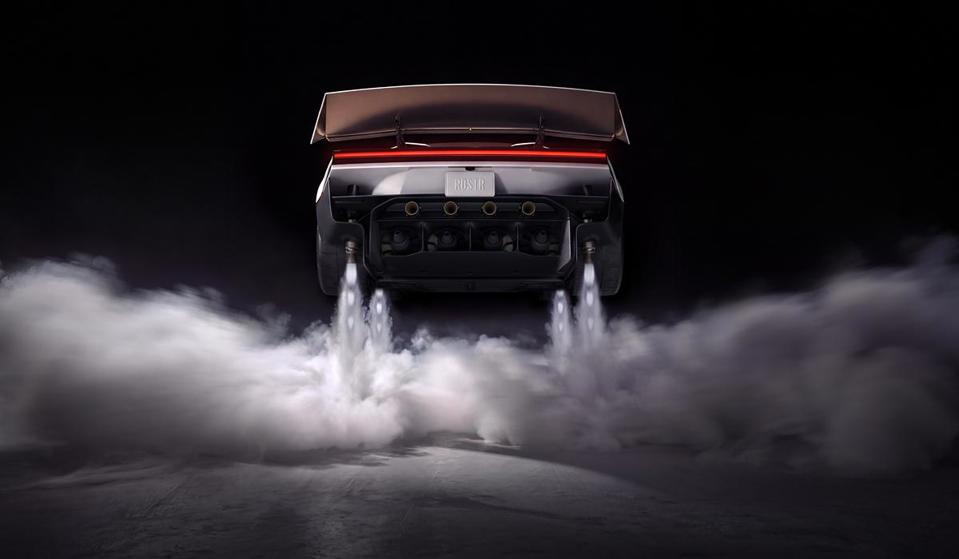
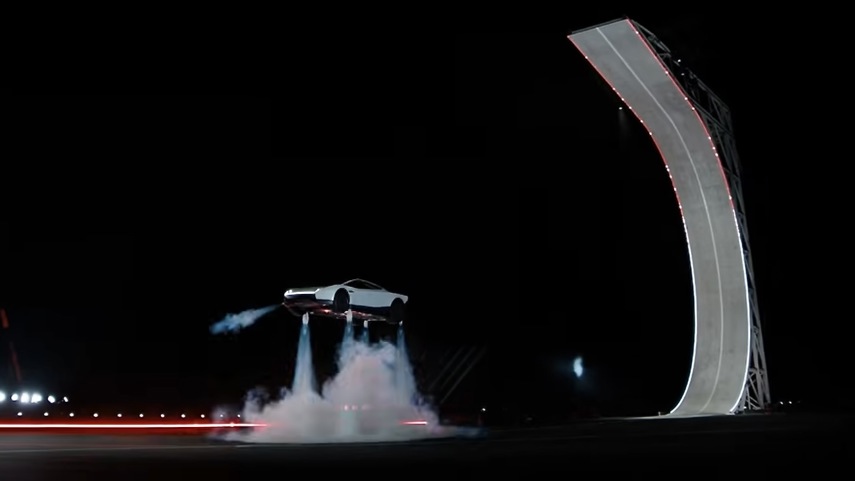
The most extreme tier - the Rocket - adds a massive secondary 400-litre nitrogen tank in place of the passenger seat, expanding total tank capacity to 600 litres and also adds six extra thrusters under the car - bringing the total to ten - with jets on all four corners for pitch and roll control, plus two up front for yaw control. The combined 80 to 90 kilonewtons of thrust allows the car to perform short levitation manoeuvres, controlled hops, and mid-air directional control.
Can it really fly?
Because cold gas propulsion relies entirely on mechanical gas expansion rather than burning chemical fuel, usable thrust follows a balloon-like pressure curve - the system delivers its absolute maximum force at initial discharge when tank pressure is at 10,000 PSI, with thrust naturally tapering off as gas exits the vessel and internal pressure drops.
As a result, actual use time comes in short, burst-like windows designed for instant launch acceleration or brief airborne hops rather than continuous cruising. Flying? Not really, more like extreme controlled hops.
This is where we get to the part of the reveal that stretches into the grey area between reality and Elon Musk's over-excited claims. While Musk made a sweeping statement that the thrusters ran on "air" and that the car could recharge its own tank, the reality is somewhat more grounded.
As mentioned earlier, the Roadster uses compressed nitrogen to power its thrusters - which, to be fair to Elon makes up 80 percent of the air we breath - but there has been no clear details on exactly how it will do this.
Actually extracting nitrogen from air would require an immense amount of electricity and a Pressure Swing Absorption system that consists of multiple large and heavy membranes, filters and valves, making it infeasible in a car.
Because air is 80 percent nitrogen, Tesla could compromise and us an onborad ultra-high pressure ambient air compressor, which would work with the cold gas thrusters. However, this throws moisture into the equation, with the water vapour condensed by the extremely high pressure potentially flash freezing the thruster nozzles, clogging them with ice. Which wouldn't be good mid-jump.
The cars used in the demonstration used pure nitrogen, with the 600-litre Rocket model that did all the jumps actually taking between 6 and 7 hours to refill, providing between 5 and 10 seconds of thrust, while the Thrust model would take around 2 hours to fill its 200 litre COPV, meaning it would only likely be able to do one or two zero to 100 runs between fills. Moravy stated that Tesla engineers are actively developing a rapid compressor system aimed at cutting refill times down to around 30 minutes.
What is the reality of it all?
While the whole rockets and flying thing is clearly a bit overstated in terms of cars customers will actually be able to buy (and drive - the legality of the system is still an unknown and a likely nightmare of regulation and bureaucracy), the underlying EV tech of the Roadster is still massively impressive. The battery composition and cooling tech, as well as new compact but extremely powerful motors will have a tangible trickle down effect across lesser models.
And while the thrusters remain a pretty much headline grabbing gimmick, they are a very silly, completely unnecessary, but totally wonderful gimmick that we would be terrified - but desperately keen - to try.


